
Posted on Leave a comment

How to make polymer clay beads and ornaments

polymer clay beads DIY tutorial

Follow our tutorial and learn how you can make beautiful polymer clay beads using spun cotton shapes as lightweight fillers. This creative tutorial is courtesy of Greek clay artist Klio Tsaliki (https://www.etsy.com/people/1000and1).

Any spun cotton shapes (egg, roll, cone, teardrop…) can be covered with polymer clay to create unique jewelry pieces or decorative items. The final pieces can reflect the original nature of the shapes, or transform them in creative ways.

Polymer Clay Beads tutorial Step 1: drilling through the ball

As you can see, all spun cotton balls carry a hole at the bottom. However, this hole doesn’t go through the ball. For this purpose you need to “continue” the drilling to the other end, to create the tunnel which is necessary to pass the headpins or other stringing materials.

Spun cotton ball

To do this you can use either the needle you use to drill your unbaked beads, or any drilling tool sharp enough to pass through the spun cotton layers. Insert the drilling tool through while rotating it, moving your tool towards the opposite side, to make the hole. Don’t use drilling tools like Dremel for example, you may destroy the shape.

drilling tools

Klio’s drilling tools

Always work slowly and patiently, not only for your own safety but also to protect your shape which is made out of paper and it will deform if you press or treat it hardly.

how to pierce a spun cotton ball

Having completed the drilling process, rotate the tool a couple of times, to make the hole perfect and similar to the original one, at the opposite side. Now you have a nicely drilled through shape and you are ready for the next step.

Step 2: Cover the ball with a first layer of clay.

To cover the shape, prepare a rather thick sheet of scrap polymer clay and run it through the pasta machine to make it smooth. Cut a strip long enough to wrap the shape.

Spun cotton ball and clay sheet

Using Sculpey “Bake and Bond” (or any other brand you have in hand for the same use), apply some “glue” on the strip. This step is necessary, because the spun cotton shape is not smooth and so the clay will not stick on it. It is also possible to trap air between the spun cotton core and the clay which results in air bubbles after baking. Wrap the clay around the shape and then with your fingers press gently so that the clay sticks to the shape. Stretch the clay towards the top and bottom holes.

Smooth the surface of the clay with your fingers; if your item is round, roll it on your working surface with your finger to get the perfect round shape. Always remember to check that the two holes are not covered with polymer clay. If they are, use a tool to create the holes again.

spun cotton filler for polymer clay

Step 3: First bake.

Bake as any other polymer clay item, depending on the clay layer thickness, according to the instructions given by the manufacturer. Tent your tray with a piece of oven paper and stay close to the oven. Although it is safe to bake the spun cotton items, it is always better to be careful.

Let the beads cool down normally. When they are at normal temperature, you can cover them as usual.

Step 4: Add the second layer of clay

This first layer offers a stable and smooth surface.  You can then apply more layers, depending on the technique you want to use. I suggest to use again a bit of “bake and bond” between the first and second layers, the baked and the unbaked. This process will keep the two layers together during the baking time.

Cut a strip of a skinner blend or any other clay sheet you are planning to use.

polymer clay ornaments DIY

Apply some “bake and bond” on the baked bead and wrap the bead carefully.

bead clay glue

Wrap the already baked bead with the final clay sheet and work the top and bottom parts around the holes as discussed earlier. Make sure there is no clay over the holes. After baking it will be difficult to find them if it they are covered with clay.

polymer filler aluminum foil alternative

Cut two thin strips of clay and wrap around the bead. Make sure to cover the seam (where the green clay meets the blue clay on the picture). Your polymer clay bead is now really starting to take shape.

polymer clay sphere

Using your mini cutters cut mini circles of different sizes in pairs, one for the top and one for the bottom of each beads, playing a bit with the different colors used in the basic clay sheet which covers the bead.

polymer clay bead how to

Stack them putting the biggest at the bottom and the smallest on top.  Drill them all at once with your drilling tool (needle etc). Place them over the predrilled holes of the bead and with your drilling tool make sure that all the holes are properly aligned so that the headpin will pass properly.

Polymer Clay beads DIY tutorial

You can make your future polymer clay beads even more interesting by giving them a little texture. (This has an extra advantage: it removes the fingerprints). Press slightly and gently a piece of fabric i.e. a piece of an old jeans, a sponge, anything which is large enough to wrap your bead and give it a texture.

How to make polymer clay bead DIY

Step 5: second bake

Bake as usual, covering the beads or items you made with some oven paper. Always stay close to the oven during the baking process and keep an eye on your items.

Note: When possible, because the ball will be covered with two layers of clay, select a spun cotton ball a bit smaller than your target bead size.  Also remember that a thicker second layer is less likely to keep air bubbles between itself and the prebaked bead.

Let the beads cool down normally. When you try to pass the headpin through, always start with the original hole. As you twist your drilling tool in the hole, you create a tunnel which works much better when you follow the original direction.  Sometimes, if the item is big, you may need to try a few times until you find the opposite hole. It is normal, don’t push and be patient. Use a long needle to make sure your hole is still open and try again.

You can use the smaller sizes for jewelry use and the bigger ones for craft and decorative use. Make Christmas ornaments, mobiles, enjoy this new way of using your favorite polymer clay. As spun cotton shapes are very lightweight, you can create bigger items without the challenges of the extra weight. So many shapes, so many possibilities!!!

More work by Klio:

Polymer clay charm mobile pendants

Incredible polymer clay beads and charms mobile.
We can hardly imagine the work that went into this project!

Posted on 2 Comments

Fabric covered bead necklace – DIY tutorial

Fabric covered bead necklace tutorial DIY

Follow our tutorial and learn how you can make a beautiful and comfortable Fabric Covered Bead Necklace using spun cotton balls are lightweight fillers.

fabric covered bead necklace how to tutorial
fabric bead necklace

Materials to make one fabric covered bead necklace

  • 14 spun cotton balls, 1.18″ diameter (30mm).
  • A long and narrow, 4.5″ x 90″ (7.5′) strip of silk fabric. You will have to stitch two 4.5″ x 45″ pieces together.
  • Needle and some extra strong thread (or better, a sewing machine if you have one).
  • A long ruler, pencil, scissors, or craft knife, paper clip.
spun cotton balls for necklaces
Spun cotton balls come in many different sizes

Directions

Step 1: Cut a long and narrow strip of fabric (4.5 inches x  7.5 feet)

Fabric covered bead necklace tutorial step 1

At the fabric store, you probably will not find a piece of fabric that is 7.5 feet long. Fabric comes on bolts and bolts are typically 36″, 44″-45″, or 54″ wide. So you may have to sew two pieces of fabric together.

The fabric I bought came on a 45″ wide bolt. So I ended up having to sew two long and narrow strips of fabric together to achieve the required length.

To cut the fabric, I used a long ruler and a craft knife over a piece of plywood. I cut two strips, each measuring 4.5″x 45″. It’s ok to use a pair of scissors if you don’t want to mess with a sharp knife. The cut doesn’t have to be exactly straight.

Before sewing the 2 strips together, I overlapped them by about an inch. [divider_flat]

Step 2: Fold the strip of fabric into a tube shape

Fabric covered bead necklace tutorial step 2

Fold the long piece of fabric in half lengthwise and sew the long edges together. Try to sew small stitches for a more secure seam. This is easy to accomplish but time consuming without a sewing machine.

VERY IMPORTANT: For now, the “good” side of the fabric goes inside the tube. We will turn the tube inside out once the sewing is done.

Once done with sewing, turn the tube inside out with a loop turner or a paper clip.

The paper clip method:  Start by solidly anchoring the paper clip to one end of the tube (it’s ok to poke a hole in the fabric with the paper clip). Then, just slide the clip through the tube from one end to the other. The tube will turn inside out very easily. [divider_flat]

Step 3: Slide in the spun cotton balls and tie the knots

Fabric covered bead necklace tutorial step 3

Tie the first knot where you sewed the two strips of fabric together (to hide the stitches).

Slide a ball down one end of the tube until it reaches the middle of the necklace. Twist the fabric to push the ball as close to the middle as possible and tie a simple knot.

Slide a second ball down the other end of the tube, twist the fabric and tie a new knot.

Do the same with all the balls or until the desired necklace length has been reached.

Step 4: Adding finishing touches to your necklace

Fabric covered bead necklace tutorial step 4

For the endings to look nice, fold the fabric to create a 45 degree angle. Sew along the edges.

Iron your fabric covered bead necklace on low heat to remove all the wrinkles. You are done :)

Fabric covered bead necklace tutorial DIY

I hope you enjoyed this tutorial. As always, if you have any questions, do not hesitate to get in touch. Happy crafting!

Note: If you like this tutorial, you may also enjoy my other necklace tutorial: Paper bead necklace DIY.

Posted on Leave a comment

How to make your own BLANK KOKESHI DOLLS

Kokeshi doll blank bodies DIY tutorial

In this tutorial, learn how you can make your own blank kokeshi dolls from spun cotton shapes – a fun and creative DIY project for all ages.

Blank Kokeshi Dolls DIY – Project materials

  • Glue gun or tacky glue, both work well.
Blank Kokeshi Dolls

You can also create you own blank Kokeshi dolls by using different shape combinations. Below are a few shapes that you can use together. From left to right: Eggman Figurine Large, Eggman Figurine Small, Eggman Figurine miniature, Figurine Torso Large, Figurine Torso Small, ø 25mm Truncated Ball.

Kokeshi blank bodies spun cotton

Step by step directions

Kokeshi Dolls Blank Bodies DIY step by step
  1. Choose a combination of blank shapes that you like.
  2. Simply glue the shapes together. For a strong hold, make sure to pour glue in the little holes underneath the shapes.
  3. It is now time to get your paintbrushes and paint colors ready :)

Painting Suggestions.

Now that you have created your Kokeshi doll bodies, it is time to grab your paintbrushes. Here are a few painting designs you can use for inspirations.

To paint the blank dolls, I like to use acrylic paint because it dries fast, and it’s easy to work with. However, any paint that works on paper will also work on spun cotton shapes. For your kokeshi dolls to look nice and shiny, you can finish them with a clear coat varnish. Mod podge for example works very well.

You can also check out our “how to paint peg dolls tutorial” for more general painting tips and advice (link).

The last two Kokeshi painting suggestions are a little more elaborate. We used 40mm tall spun cotton eggs for the bodies, ø 45mm spun cotton balls for the heads, and ø 15mm spun cotton balls for the hair buns.

I hope you enjoyed this tutorial. As always, if you have any questions, feel free to comment, we are always here to help.

Happy crafting!

Posted on Leave a comment

How to paint and decorate Spun Cotton Eggs

Easter egg ornaments pattern ideas

Check out our tutorial and learn how to paint and decorate Spun Cotton Eggs. We’ll also share with you some of our painting projects for inspiration purposes. Decorating eggs is a fun family friendly activity for Easter or anytime of the year.

Painting Spun Cotton Eggs – the basics

Spun Cotton Eggs are made of paper and are very easy to paint and decorate. You can use any acrylic paint that you find at craft stores.

Blank spun cotton egg ornaments

To paint a spun cotton egg, start with inserting a wooden pick (a bamboo skewer for example) at the bottom of the egg (they all have a small hole at the bottom). When this is done, simply hold the bamboo stick in one hand, and your paintbrush in the other hand. This way, you can paint the egg without getting paint on your fingers.

Spun cotton Easter egg ornaments

If you want to paint a straight line around the egg, simply spin the bamboo stick between your fingers while you hold the brush steady against the spun cotton egg.

You can also decorate the eggs with Glitter, trims of paper, Dresden… To do so, you can simply use regular white tacky glue, it works very well.

You can visit our online store Spun Cotton Egg Page to browse through our large collection of sizes and styles.

Project idea #1: Solid color Easter egg ornaments

These are the easiest of all Easter egg ornament projects. We used 60mm spun cotton blank eggs and covered them with one layer of regular acrylic paint. 60mm eggs are a popular size because they are the size of real eggs.

How to paint spun cotton eggs for Easter

Project Idea #2: Solid color eggs with patterns

Below are a few patterns that you can use for inspiration.  

Easter egg ornaments pattern ideas

Project Idea #3: Eggs tied in ribbons!

Easter egg ornaments can be decorated with almost anything: ribbon, paper, fabric, felt, crystals, beads, glitter. For the picture below, I used a simple red ribbon and tied it into a knot.

Easter egg ornaments craft ideas

Project idea #4: Eggs decorated with homemade decals

It is possible to make your own decal, with just a printer and a box of tissues.

Vintage spun cotton egg ornament DIY

Vintage Rabbit decal on 60mm Spun Cotton Egg

Here is the technique:

  • Search the internet for an illustration that you like. Make sure not to use any copyrighted work.
  • Open your image in an image editor. Adjust the size of your image so that it fits the size of your spun cotton egg. Verify that the size is right by printing the image and comparing it to the size of your egg.
  • Tape a tissue (the kind we blow our noses in) onto a piece of printing paper. It is important to use a thin type of tissue, like the ones that come in boxes. Feed this paper to your printer and print your illustration on the tissue side of the paper.
  • Cut out your illustration. To do so, just imagine an oval line going around your image and cut out along this line. Leave about 1/4″ between the edges of your image and the edges of your oval shape.
  • Only use the upper ply of your tissue (the one with the print on).
  • Brush mod podge or tacky glue over your spun cotton shape.
  • Gently lower your print onto the egg.
  • With a clean finger, tap around the print to make sure it is flush against the shape. Be careful not to tap on the ink or you may smear it.
  • Brush a little more mod podge or tacky glue over the tissue. Don’t brush directly onto the ink. It will smear.
  • Brush over the wrinkles to make them disappear.
  • When the mod podge or the glue are dry and clear, you will not see the tissue over the spun cotton egg anymore. Instead, it will look like a decal.

Note: The print transfer technique works with both color and black and white prints.

retro doll head egg spun cotton ornament DIY

Vintage Doll face Decal

Displaying your work of art

You could display your painted eggs in little nests made of straw or small twigs, hang them from a door handle or a kitchen hook, or display them in vases (picture below).

Easter egg ornaments display ideas

We hope you enjoyed this tutorial and found some ideas for your own projects.

Do you have any questions about this page? Please feel free to leave a comment below!

Posted on Leave a comment

How to make decorative owl figurines – DIY tutorial

Owl figurine craft DIY tutorial

Follow our tutorial and learn how you can easily make beautiful, decorative owl figurines from our blank figurine shapes.

DIY Owl Figurines – Project Materials

  • SPUNNYS EGGMAN BLANK FIGURINE – large (72mm which is about 2 3/4 inches). The Eggman shape looks like an egg with a flat bottom.
  • Paint and brushes. I used 5 paint colors (Gold, Ivory, light brown, saffron, and black). You can use the same colors or pick your own. Most types of paints work but I typically use acrylic or enamel.
  • A pencil to outline the facial features of the owl prior to painting.
  • A bamboo skewer to hold the blank shapes while you paint and decorate them.

Step by step tutorial 

1: Body painting

Paint the whole spun cotton shape one solid color.

Tip: You can squeeze the paint directly from the tube onto the shape.

2: Paint the face and beak

Outline the face of the owl and the beak with the pencil. Don’t press too hard on the pencil or it may dent the spun cotton (and if you are using a light paint color, the pencil marks may show through). When you are done outlining, you can paint the face and the beak.

Tip 1: For your first owl, I recommend using the paint straight out of the tube (vs making a custom color by mixing two colors). This way if you have to touch up your owl later on, the same exact color can be used again.

Tip 2: A small tiny brush works best for the beak. If you do not have one, a black fine point marker works fine too.

Spun cotton owl figurine DIY

3: get started with the eyes

When the face and the beak are dry, paint two discs (outline first with a pencil).

Blank unpainted owl figurines

4: The irises

When the two discs are dry, paint the eye irises. I painted mine yellow. Without the pupils, the owl figurine looks pretty scary :)

Owl figurine DIY tutorial

5: The pupils.

Finish your owl figurine by painting the eye pupils. I painted mine black so they stand out.

Owl figurine DIY tutorial home decor

You are already done :) A beautiful Homemade Owl Figurine

I hope you enjoyed this tutorial and I hope you found some inspiration for your own owl figurine projects.

Note that SPUNNYS figurine bodies can be used for many more DIY Craft Projects beside owls. Use them to make penguins, walruses, woodland animals, super heroes, and much more.

As  always, if you have a questions, do not hesitate to use the comment section below. Happy crafting!

Posted on Leave a comment

How to make adorable penguin figurines – Winter DIY Crafts

penguin figurines

Check out our step by step tutorial and learn how to make adorable little penguin figurines from blank spun cotton shapes.

Penguin Figurines – project materials

The essentials

● 12mm spun cotton balls and 20mm spun cotton eggs.

Spun cotton balls bulk sizes.
Spun Cotton Balls
blank spun cotton eggs
Spun Cotton Eggs

● Some glue. You can use white tacky glue or a glue gun.
● Black paint and a paint brush. Acrylic word well and dries fast. It’s also fine to use a black marker.
● A little piece of orange foam pad for the beak and feet. A piece of cardboard or strong paper painted orange would work too.
● A pair of scissors.

Optional (nice to have but not necessary):

● Bamboo skewers or toothpicks. They make it easy to hold the spun cotton shapes during the painting process.
● A pencil (to outline before painting).
● A fine black marker (to paint the eyes).
● A clear varnish to protect your work. I like to use mod podge because it’s non-toxic.

Directions

1: Paint one ball and one egg with black paint. Leave the belly and face areas blank.

How to make a penguin ornament

It helps to use a toothpick to hold the spun cotton shapes. 

2: When the paint is dry, glue the ball on top of the egg.

3: Draw the eyes with the black pen

4: Cut the feet and the beak in the piece of orange foam and glue them on.

More Penguin Figurine DIY Craft ideas:

You can also use different type of spun cotton shapes or combine spun cotton shapes and pipe cleaners.

More Winter DIY craft ideas

You can also use spun cotton shapes to create Polar Bear Figurines. Here are a couple of ideas.

In the above right-side picture, the large penguin and bear are made with 45mm balls for the bodies and 30mm balls for the heads (and 15mm balls for the bear paws)

We hope you enjoyed these penguin craft ideas. As always, if you have any questions, do not hesitate to get in touch or to leave a comment. Happy crafting!

Posted on Leave a comment

How to make cake topper figurines with spun cotton shapes

cake topper figurines DIY tutorial

Check out our tutorial and learn how you can easily make your own cake topper figurines from spun cotton figurine shapes. Spun Cotton Shapes are ideal materials to make cake toppers because they are plastic free, easy to paint, and they can be mounted on wooden picks.

blank unpainted cake topper figurines

DIY Cake Topper Figurines – Materials

Only a few materials are required:

  • Spun Cotton Figurine shapes.
  • Paint and brushes. We recommend that you use only non-toxic paint.
  • A non-toxic water based finish such as mod podge.
  • A pencil to outline the cake toppers before painting.
  • A black pen to draw facial features.
  • Toothpicks.

Step by step directions

1: select your spun cotton figurine blanks

Spunnys offer a wide selection of figurine blanks.

2: paint your toppers

You can check out our “how to paint peg dolls tutorials” for a list of tips and advice.

3: display the toppers on the cake or cupcake

Use toothpicks to display the toppers. Spun cotton shapes all have little holes at the bottom.

Painting cake topper figurines – tips and tricks

  • To make painting easier, you can hold the figurine shapes via a wooden pick. A bamboo skewer works great.
  • To rest your painted toppers in a safe position while they dry, simply place the sticks in a container such as a tall glass.
  • Always outline with a pencil before painting.
  • When you draw the eyes, make sure to place them in the middle of the head.

CAKE TOPPERS – Project examples

wedding cake toppers easy DIY

A cute wedding cake figurine topper DIY idea.

I hope you enjoyed this tutorial. As usual, if you have any questions, please do not hesitate to get in touch or to leave a comment. Happy crafting!

Posted on Leave a comment

How to make Crepe Paper Flowers – Streamers Poppies

Paper flower tutorial step by step

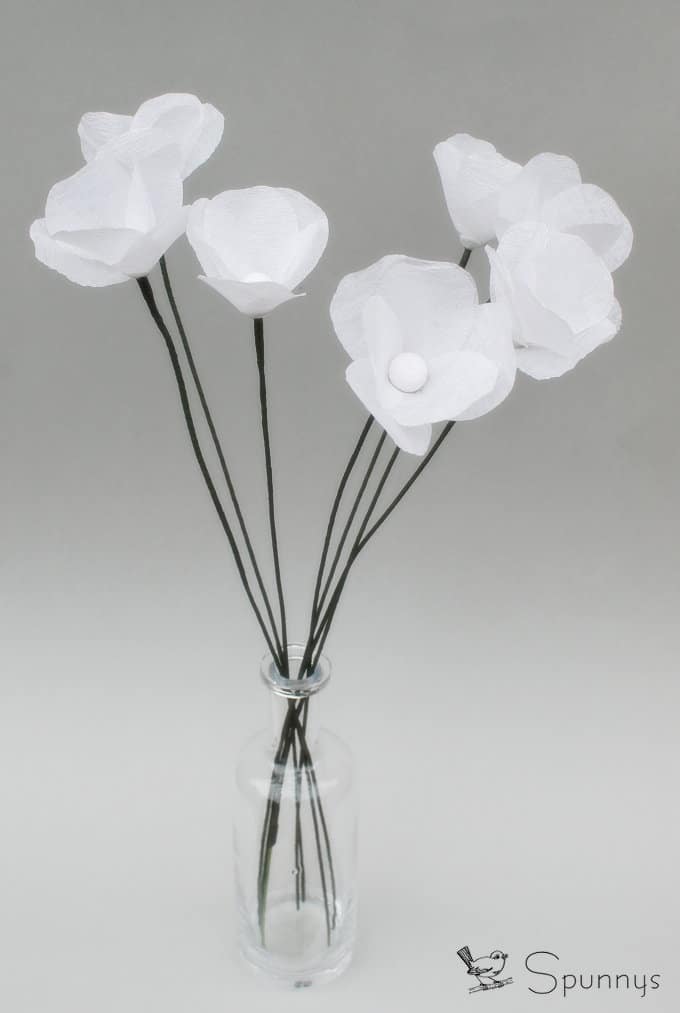
Follow our detailed tutorial and learn how you can make beautiful and elegant crepe paper flowers out of streamers. We will use poppies as example and will provide plenty of pictures to help you along the way.

Crepe Paper Poppies – List of Materials

  • Crepe paper streamers – 1 roll (1 – 3/4″ wide). You can make dozens of flowers with a single roll. I recommend white to start because glue spills don’t really show on white.
  • Spun cotton balls – white – 15 mm diameter (.59 inches). 1 ball per flower.
  • Sharp scissors.
  • Pencil.
  • Low temperature glue gun and glue sticks.
  • Stem wire. The wire I used for these flowers is 18 gauge and 18″ long. I found it at Michaels.
  • Floral tape.
  • A small piece of cardboard to make your petal template. Or you can just print my template on regular paper and cut it out (link below).[/threecol_two_last] [divider_flat]

Directions

Note: I recommend a low temperature glue gun so you don’t burn your fingers.

Step 1: Gather all your materials.

Make sure to set up in a location where there is no air circulating (the petals fly off easily).

Step 2: Make one petal template for all your future crepe paper flowers

You can download the template (link below) or just copy from the picture. (It is not an exact science). My petals are 1-11/16″ wide and  1-1/2″ tall.

Click here to Download the petal template. When printing, make sure to set the scale at 100%. 

paper flower materials
handmade paper flowers

Step 3: Cut out 6 identical petals.

Fold the crepe streamer 6 times onto itself. Outline the shape of a petal on the top layer. Cut out all layers at once with a sharp pair of scissors.

paper flowers DIY
paper flower template

Step 4: Glue the spun cotton ball onto the stem wire.

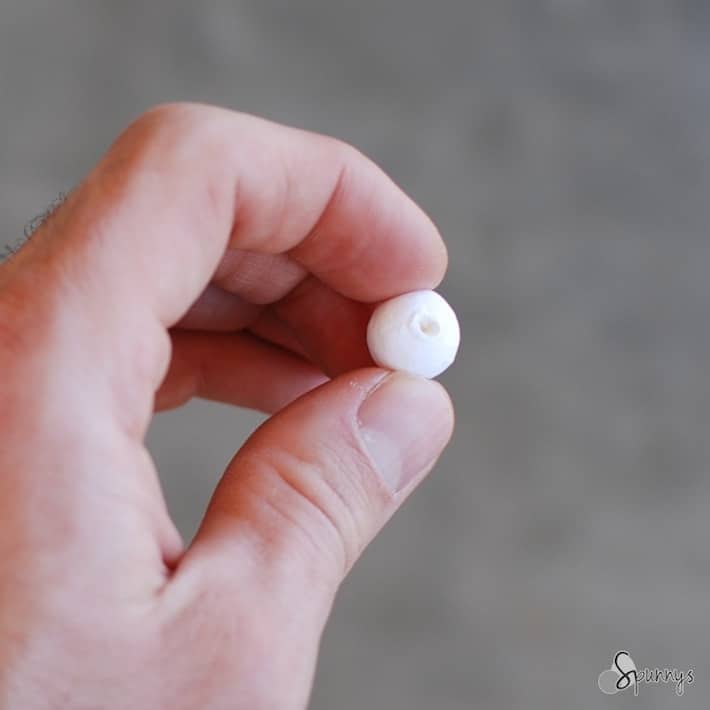
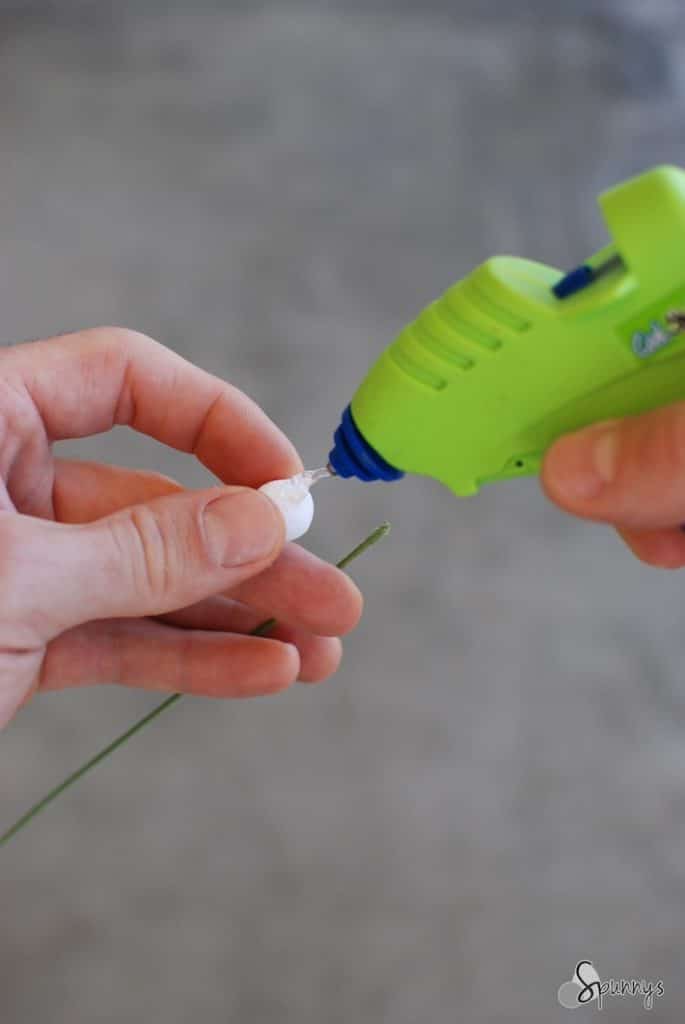
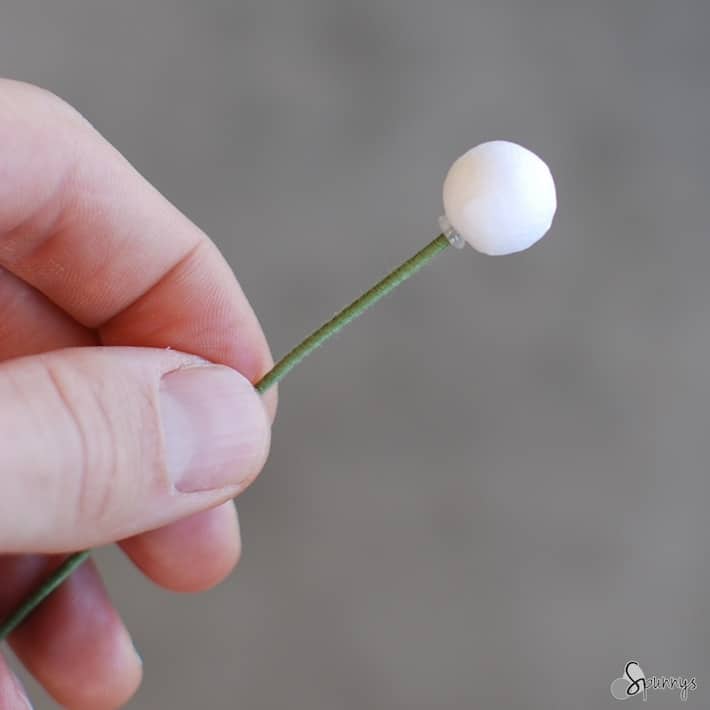
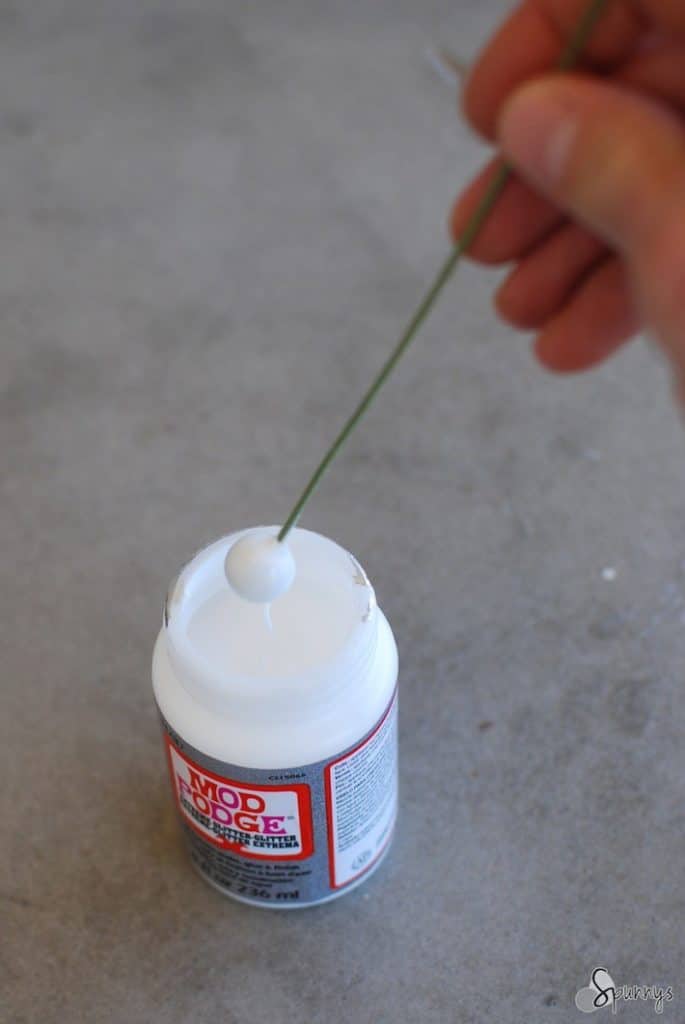
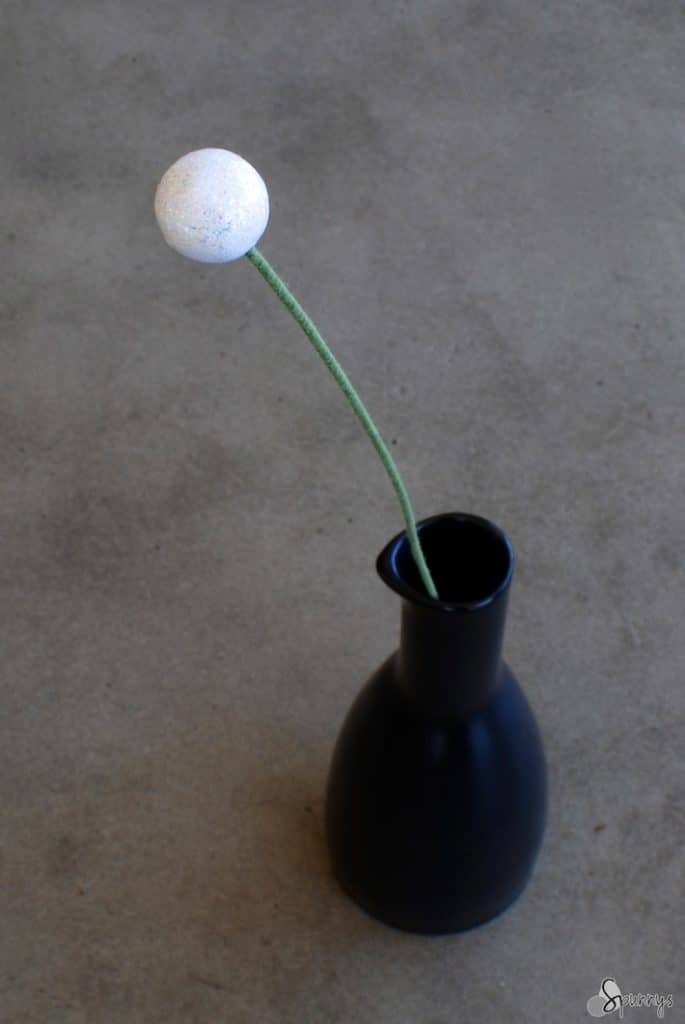
Pour a generous amount of glue over the hole and immediately insert the stem (all spun cotton balls have a little hole). Wait 5 seconds for the glue to become moldable. Quickly, shape the glue into a cone shape with your index and thumb fingers.

spun cotton ball 15 mm
floral stem wire project ideas
paper flower pistil ideas
floral stem wire craft ideas

It is important to create a little “cone” of glue under the ball.
It will make for a nice surface to glue the petals to. 

Step 5: Make the support cone a little bigger

Pour a little more glue all around the cone, wait 5 seconds for the glue to become moldable, press down with your thumb and index fingers to shape as a cone.

floral craft ideas
spun cotton ball flower how to

Step 6: Add petal #1.

Pour a horizontal bead of glue about 3/8″ long right at the junction between the spun cotton ball and the support cone. Line up the bottom of the petal with the bottom of the cone and press the petal against the glue. The petal should cup around the ball.

glue gun flower crafts
DIY paper flowers

Step 7: Add petal #2.

Petal #2 needs to overlap petal #1 by a little bit (about 1/3 “).

paper flower instructions
tutorial paper flowers

Step 8: Add petal #3.

Petal #3 should fit right between petal #1 and petal #2, overlapping them a little bit on each side. Glue into place using the same technique as for petal #1 and 2. When done, your three first petals should look evenly distributed around the ball.

paper flowers simple instructions
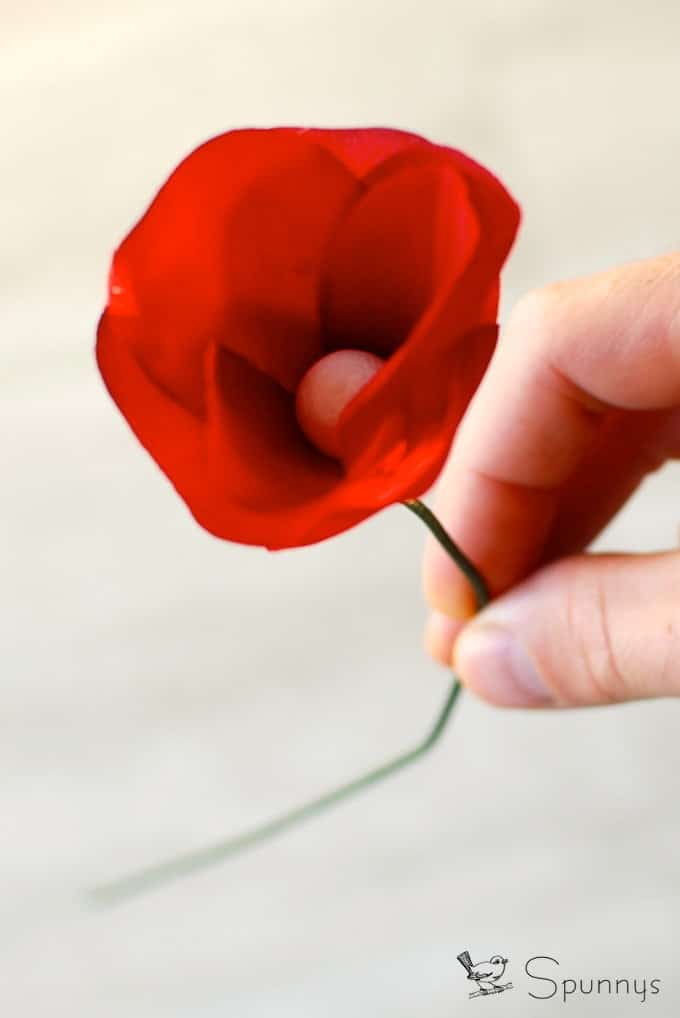
crepe paper poppies

Step 9: Add petal #4.

Pour a 3/4″ horizontal bead of glue across petals #1 and 3. This glue line should be a little bit higher up (maybe 1/4″) than the first 3 petals glue lines. Position petal #4. Press down against the glue. Petal #4 should cup around the ball

how to glue paper flowers
crepe paper flowers

Step 10: Add petal #5.

Following the same technique, glue petal #5 exactly between petals #2 and 3.

paper flower crafts

Step 11: Add petal #6.

Still with the same technique, glue petal #6 exactly between petals #3 and 1.

how to make paper flowers
paper flowers

Step 12: Apply the first piece of floral tape.

We want to give the crepe paper flower a clean look by covering the very bottom of the petals and hiding all the imperfections. Cut a 5″ long piece of tape. Start twisting the tape around the stem at about 1/2″ below the flower. Go about 2 turns. Then work your way up the stem until the tape covers the very bottom of the petals. Stay up for about 3 turns. Work your way down until you run out of tape.

how to use floral tape
make paper flowers
easy paper flowers
tissue paper flowers

Step 13: Finish wrapping up the stem with floral tape.

Cut a 16″ long piece of tape, start where you ended, and work your way down. Maintain a sharp angle and moderate tension.

paper flower DIY

This is it
You made it! 

crepe streamer paper flower tutorial

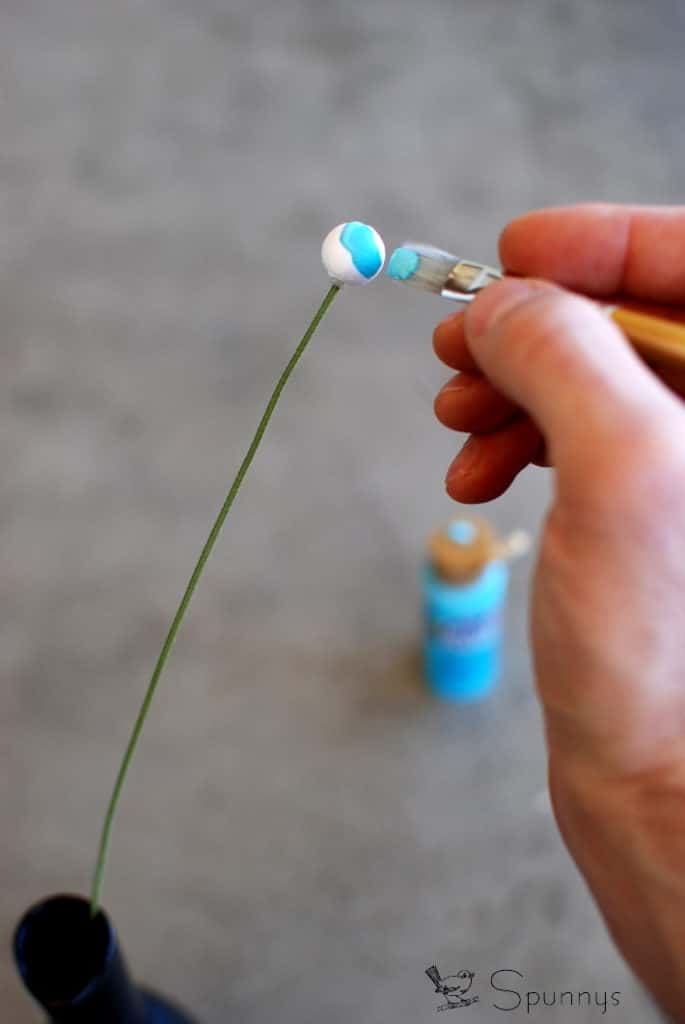
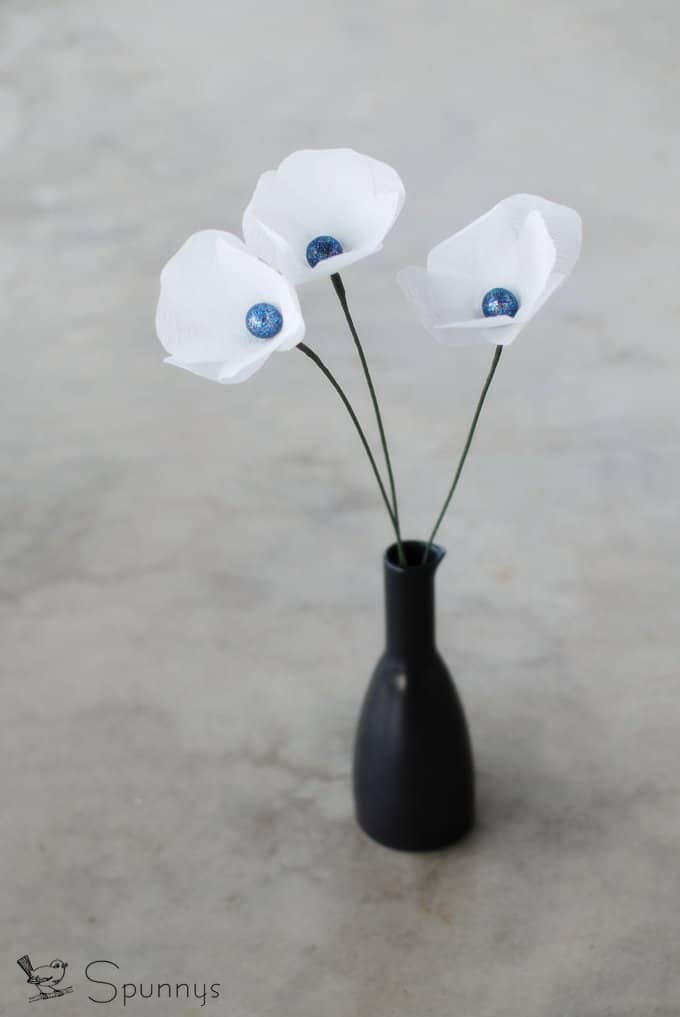
Try to make another crepe paper flower, you will be an expert in no time. For variety,  you can try different color crepe paper rolls. You can also paint the spun cotton balls.

I hope you enjoyed this tutorial and found some inspiration for your next projects. As usual, do not hesitate to get in touch if you have any questions.

Crepe Paper Flowers – same technique, more project ideas:

Posted on Leave a comment

How to make Vintage Easter Rabbit and Chicken Ornaments – DIY Crafts

Vintage Easter Ornaments DIY Chicken Rabbit

Follow our tutorial and learn how you can make Vintage Style Easter Ornaments from spun cotton balls and colored card stock.

The templates for the bunny and chicken silhouettes can be downloaded below.

PROJECT MATERIALS

  • Colored stock paper or cardboard (make sure the two sides are colored).
  • 40mm spun cotton balls. The downloadable silhouette templates below are just the right size to work with 40mm balls.
  • A good pair of sharp scissors
  • A pack of Christmas ornament hooks (see picture below). You could also make your own with small gauge metal wire.
  • A few pieces of colored ribbon
  • Paint and paintbrush.
  • A glue gun or tacky glue.
  • A rubber band.
  • A bread knife.

STEP BY STEP TUTORIAL

Step 1: Gather all your materials

spun cotton balls 40mm

40mm diameter spun cotton balls

Spun cotton ball ornament hook

A pack of hooks

Step 2: Paint the spun cotton balls. We created our own off-white color by mixing a little bit of yellow paint into white paint.

Ball ornament DIY

A toothpick comes in handy to hold the balls. 

Step 3: Outline the chicken and rabbit silhouettes onto the colored stock paper (you can download our silhouettes or create your own). Once the silhouettes are outlined, carefully cut them out with the pair of scissors.

vintage Easter ornaments handmade

Step 4: Draw ø 40 mm circles on the silhouettes to mark where the balls will ultimately be positioned. Then draw a second smaller circle within the larger circles. Finally draw a vertical line in the middle of your circles.

How to make Easter ornaments

You can use a coffee pod to draw the inner circles.

Step 5: Cut each silhouette in half. Then cut out the inside part of the inner circles.

Chicken and rabbit ornaments DIY

Step 6: Tie a rubber band around a ball so as to create two identical halves. Draw a pencil line along the rubber band, remove the rubber band, and with the bread knife, make a quarter inch incision along the line.

Repeat with the other ball.

Easter ornaments tutorial

Step 7: Pour a little glue in the holes and insert the metal loops. Hold the loops in position for about 15-30 seconds until the glue is dry. If you are using tacky glue, you will have to wait a couple hours for the glue to dry.

Easter ornaments to make

You can re-shape the metal loops a little bit so that they are easier to insert in the holes. 

Step 8: Simply slide the cardboard silhouettes into the incisions.

Vintage Easter ornaments DIY craft ideas chicken rabbit

Step 9: Use little pieces of ribbon to hang your finished ornaments.

Vintage Chicken ornament spun cotton DIY

You are done :)

I hope you enjoyed this tutorial and and as usual, do not hesitate to send us your questions or use the comment fields below.

Posted on 4 Comments

Miniature Pipe Cleaner Hats – Easy DIY Tutorial for Crafts & Ornaments

miniature pipe cleaner hats DIY tutorial

Looking for a fun and creative craft project? In this step-by-step DIY tutorial, you’ll learn how to make miniature pipe cleaner hats using simple materials and an easy weaving technique.

With just a little practice, you can create beautiful mini hats in about 5 minutes each — perfect for:

  • Peg dolls and figurines
  • Holiday decorations
  • Miniature ornaments
  • Gnomes, elves, and craft characters

Once you master the basic technique, you’ll be able to make many different hat styles for all seasons and themes.

One Simple Technique – Endless Hat Styles.

Using this easy pipe cleaner weaving method, you can create:

🎅 Santa hats
🧙 Wizard hats
🍀 Leprechaun hats
🎩 Mini top hats
☀️ Sun hats
🧢 Beanie hats
👒 Cloche hats
🚣 Boater hats
…and many more creative designs!

Just adjust the crown height, brim width, and shape to customize each miniature hat.

pipe cleaner hats minis miniature ornaments DIY

Materials Needed for Mini Pipe Cleaner Hats

Each miniature hat requires:

  • 4 to 5 pipe cleaners (chenille stems)
  • Wire cutters
  • Pliers

That’s it — no glue or extra supplies needed!

Choosing Your Pipe Cleaners

You can use many different types of pipe cleaners, such as:

  • Regular pipe cleaners
  • Plush or fuzzy pipe cleaners
  • Glitter pipe cleaners
  • Bump pipe cleaners
  • Narrow or wide stems

For this tutorial, we used standard pipe cleaners (12 inches long, about 6 mm wide).

Pipe cleaners are inexpensive and great for experimenting with colors, textures, and patterns.

Step-by-Step Miniature Pipe Cleaner Hat Tutorial

To illustrate the technique, we are going to make a simple hat. You can then modify this basic technique to make different styles of hats.

Step 1: Gather Your Pipe Cleaners

Start with 5 full-length pipe cleaners.


Step 2: Cut Two in Half

Cut 2 pipe cleaners in half, leaving you with:

  • 4 half-length strands
  • 3 full-length strands

Step 3: Build the Hat Frame

You’ll create a 7-arm star shape, plus one long weaving strand.

  1. Lay three half strands perpendicular across one full strand
  2. Wrap the full strand tightly around the center
  3. Pull to secure
  4. Spread the strands evenly to form a star

This star shape is the base frame of your hat.
The extra long strand will be used to weave the hat.

chenille stem hat DIY

Step 4: Weave the Crown of the Hat

Take the long strand and begin wrapping it clockwise around the center:

  • Go over one strand, then under the next
  • Continue alternating over and under as you circle

After a few rounds, you’ll form a small woven disc — this is the top of the crown.

pipe cleaner hat crown 1

Once the disc is formed:

✔ Bend the 7 arms downward
✔ Continue weaving around them to build the height of the crown

pipe cleaner hat crown 2
pipe cleaner hat crown 3

When you reach the end of a pipe cleaner, simply twist on a new one and continue weaving.

pipe cleaner hat crown 4

Step 5: Weave the Brim

When the crown is the height you like:

  1. Bend the frame arms outward
  2. Continue weaving using the same over-and-under pattern

This creates the brim of the hat.

pipe cleaner hat brim 1

Finishing Touch

Before trimming the ends:

👉 Fold all loose ends under the brim first
(This prevents metal tips from sticking out)

You can also add a decorative band using another pipe cleaner wrapped around the crown.

🎉 Your miniature pipe cleaner hat is complete!

Now try:

  • Taller crowns
  • Wider brims
  • Pointy hats
  • Flared shapes
  • Mixing pipe cleaner textures

Take Your Mini Hats Further with Craft Shapes & Decorations


Spun cotton head happy face one inch with hat
Spun cotton head 1 with hat

Mini pipe cleaner hats look even better when paired with:

  • Peg dolls and figurines
  • Spun paper balls for heads and ornaments
  • Craft shapes for characters, gnomes, and holiday décor

Using lightweight spun paper balls makes it easy to create:

🎄 Christmas ornaments
🎃 Halloween figures
🐰 Easter decorations
🧝 Mini gnomes and elves

They’re perfect for turning your miniature hats into full craft projects.

More Miniature Craft Ideas

Here are a few fun ways to use your mini pipe cleaner hats:

  • Santa peg doll ornaments
  • Gnome decorations
  • Mini character figurines
  • Holiday table décor
  • Handmade gifts

We hope you enjoyed this miniature pipe cleaner hat DIY tutorial!

If you have any questions, feel free to leave a comment below — we’re always happy to help.

Happy crafting!

Posted on Leave a comment

How to make mushroom necklace pendants from spun cotton mushroom blanks.

homemade Swarovski crystal encrusted mushroom pendant

Check out our tutorial and learn how you can easily make beautiful mushroom necklace pendants from Spun Cotton Mushroom blanks. 

mushroom necklace pendant tutorial

Project materials: 

– Small size Blank spun cotton mushrooms.
– Your choice of acrylic paint colors (any paint that works on paper will also work on spun cotton).
– A high gloss varnish.
– A few jewelry eye pins.
– A jewelry plier set (flat nose, round nose and side cutters). You could get away with just a pair of wire cutters.
– A few toothpicks or bamboo skewers.
– A safety pin.

Step by Step Directions: 

Below is a detailed pictorial followed by written instructions.

mushroom necklace pendant DIY pictures

1/ Gather all your materials.

2/ With a safety pin, pierce the mushrooms from one end to the other.

3/ Slide the eye pins in the holes you just made to make sure they fit.

4/ With the wire cutter, shorten your eye pins. They need to be a little shorter than the mushrooms.

5 to 7/ Grab the cut-off portions of your eye pins. With the round nose plier, make little loops and cut them loose.

8/ Make sure you have all the hardware you need. For 3 mushrooms, you need 3 shortened eye pins and 3 little loops.

9 and 10/ Paint the caps of your mushrooms. I like to use a bamboo skewer to hold the mushrooms while I paint them. The skewers also double as neat resting stands.

11/ When the paint is dry, paint little white dots on each mushrooms.

12 and 13/ When the dots are dry, dip each of the mushrooms into a gloss varnish all the way to the bottom of the stems.

14/ While the varnish is still wet, insert the shortened eye pins into the mushrooms caps. Push down on the pins to make sure the eye parts get in contact with the varnish. While the varnish dries, keep your mushroom as upright as possible otherwise the varnish may be thicker on one side of the cap than on the other.

15/ When the varnish is dry (it may take a few hours, maybe even an entire day depending on what varnish you used) add the little loops to each of your mushrooms. I used two pliers to open and close the loops.

16/ Tear drop finish (OPTIONAL). When you are done, you can dip the bottom of the mushroom pendant into mod podge and let it dry in an upright position. It will cover the hole at the bottom of the mushroom and give it a nice tear drop finish.

mushroom pendant DIY ornament

YOU ARE DONE! 

Project variation: Swarovski crystal mushroom necklace pendant. 

I hope you enjoyed this tutorial. Note that you can also use the same technique to make mushroom earrings or bracelet charms. Happy crafting and as always, let us know if you have any questions!

Posted on Leave a comment

How to make Pipe Cleaner Penguins – Winter DIY crafts

pipe cleaner penguins christmas craft ideas

Check out our easy tutorial and learn how to make these irresistible mini pipe cleaner penguins. They are great to decorate the house during the Holiday season and only require a few inexpensive materials.

Pipe cleaner penguins – List of materials needed

To make one pipe cleaner penguin, you will need:

1) One 10mm diameter Spun Cotton Ball and one 18mm Spun Cotton Egg. The resulting pipe cleaner penguin will be about 1.5 inches tall. For a bigger penguin, you can use larger balls and larger eggs.

2) One small strand of orange pipe cleaner and one small strand of black pipe cleaner.

3) A black ball pen, a dab of orange paint (acrylic is fine), and a very fine paint brush.

4) A pair of wire cutters and a pair of pliers.

The basic technique for this craft is to squeeze spun cotton shapes inside of pipe cleaner strands.

When a piece of pipe cleaner is twisted around a spun cotton shape, it creates pressure around the shape and locks it into place.

penguin winter craft ideas

Step by step instructions

1: Prepare the feet and the head.

For the feet, simply make a doughnut with a small piece of orange pipe cleaner.
For the head, grab a spun cotton ball and draw the eyes with the ball pen and paint a small nose with the orange paint. I used a toothpick to hold the ball.
IMPORTANT: Make sure the ball’s hole is on top of the head, not on the bottom.

spun cotton ball penguin

2: Tighten the pipe cleaner around the penguin’s head

Wrap the pipe cleaner around the head and give it 3 to 4 twists. Make sure the pipe cleaner is tight around the ball before you start twisting. You can use the pliers to help.

penguin figurine tutorial

3: Tighten the pipe cleaner around the penguin’s body and feet

With one hand, hold the feet and the body of your penguin together and with the other hand, twist and tighten the 2 strands of pipe cleaner around them.

TIP: position the portion of the feet where the two ends of the pipe cleaner meet towards the back where it doesn’t show.

penguin figurine DIY

4: Cut off the excess pipe cleaner.

You can also leave the two strands uncut and use them to display your penguin.

DIY pipe cleaner penguins

You are done :)

hope you enjoyed this tutorial. You can also use the pipe cleaner and spun cotton shape technique to create different pipe cleaner animals such as rabbits or bears – the possibilities are endless.

Thank you for reading, good luck with your penguin projects, and happy crafting!